Noise, Sweat, and Subversion: Thailand's Underground Scene Is Too Raw for the Algorithm — That's the Point
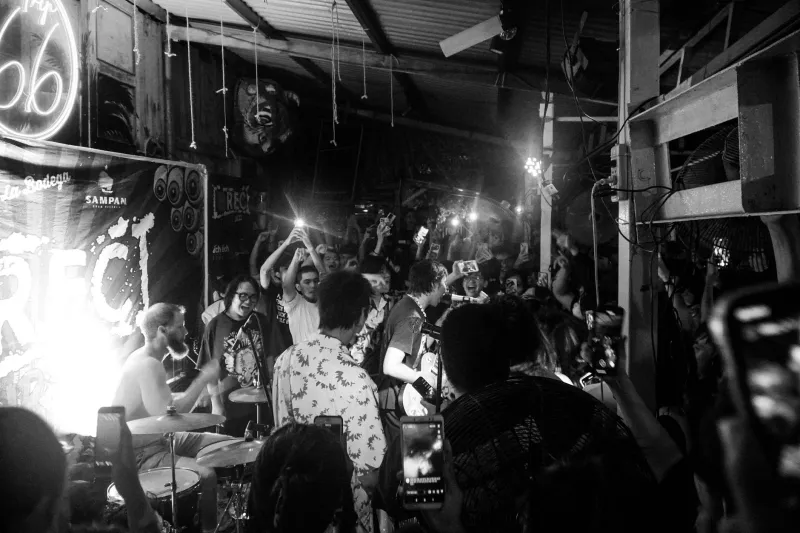
The venue doesn't have a name on the door. You find it through a Line group chat, or because someone who was there last week texted you a location pin at 10pm. The stage is a wooden platform barely elevated off a concrete floor. The PA system has seen better decades. And the artist performing — a 22-year-old from Chiang Mai who layers traditional mor lam samples over blown-out industrial percussion — is playing to maybe 80 people who are losing their absolute minds.
This is not on TikTok. This is not on Spotify's editorial playlists. This is, depending on who you ask, the most exciting music happening in Southeast Asia right now.
Anti-Viral by Design
Thailand's underground scene has always existed in the shadow of the country's massively commercial pop industry — the pristine idol groups, the polished lakorn soundtracks, the K-pop-adjacent acts engineered for regional streaming dominance. But something has shifted in the last three years. The underground isn't just surviving alongside the mainstream. It's actively pushing back against it, and doing so with a creative intensity that's starting to register on Western indie radars in a real way.
Collectives like Bangkok Noise Syndicate and the art-music hybrid crew known as Fon Trok ("Rain Falls" in Thai) are releasing material that sounds like nothing else in the global underground right now. We're talking hyperpop production values colliding with traditional Thai instrumentation, Muay Thai training audio spliced into ambient soundscapes, zine aesthetics borrowed from '90s American DIY culture and filtered through a distinctly Southeast Asian lens.
"We're not trying to be the Thai version of something Western," says Dao, a 25-year-old producer and one of Fon Trok's founding members. "We're trying to figure out what Thai chaos sounds like when it stops apologizing for itself."
The Muay Thai Aesthetic
If there's one unexpected throughline connecting Bangkok's underground visual and music scenes right now, it's Muay Thai — not as sport, but as symbol. The ancient martial art, with its rituals and its violence and its deeply specific cultural weight, has become a kind of aesthetic shorthand for a generation that's reclaiming Thai identity on its own terms.
Album covers feature fighters mid-wai kru in neon-lit gyms. Zines print Muay Thai photography alongside experimental poetry. A fashion collective called Nak Muay Jai Dum (loosely: "Dark-Hearted Fighter") makes clothing that fuses traditional boxing shorts with deconstructed streetwear, selling through Instagram DMs and pop-up events in spaces that don't exist by next month.
It's not nostalgia. It's more like reclamation — taking something that Thailand is internationally known for and warping it until it means something new. Something that belongs to this generation specifically.
"Muay Thai is already brutal and beautiful at the same time," says Mint, a visual artist and zine-maker who collaborates with several Bangkok noise acts. "That's kind of the vibe we're going for in everything we make."
The Venues, the Gatekeepers, the Vibe
The geography of Bangkok's underground is deliberately inconvenient. Events happen in Lat Phrao warehouses, in Silom basement bars that technically operate as something else, in the courtyard of a shophouse in Ari that gets repurposed every few weeks. Thonglor — Bangkok's glossy, Instagram-friendly nightlife district — is explicitly not the scene.
The gatekeeping isn't snobbish so much as protective. The community has watched enough Thai acts get scooped up, polished down, and repackaged for mainstream consumption to be wary of outside attention. There's a real conversation happening about what it means when your underground goes viral — whether it's a win or a slow death.
"When a foreign music blog writes about us, I always have mixed feelings," admits Dao. "Because on one hand, cool, people are paying attention. On the other hand, attention changes things. And what we have right now is kind of perfect because it's ours."
Why Western Indie Audiences Are Paying Attention
Here's the thing about the Western indie world in 2024: it's hungry. The American indie scene, in particular, has been in a kind of creative holding pattern — lots of competent music, not a lot of genuine surprise. The appetite for something that feels genuinely foreign, genuinely weird, genuinely made outside the algorithmic optimization loop, is real.
Bangkok's underground delivers all of that. A Fon Trok release landed on several notable end-of-year lists in the US and UK last year, shared almost entirely through music nerd Twitter and Discord servers before any publication wrote about it. A noise set recorded at one of Bangkok Noise Syndicate's warehouse events circulated through experimental music communities in New York and Berlin with the kind of organic momentum that labels spend marketing budgets trying to manufacture.
The irony isn't lost on the artists. "We made this stuff with zero interest in Western audiences," Dao says. "And somehow that's exactly why Western audiences are interested."
The Risk of the Spotlight
Not everyone in the scene is comfortable with the growing attention, and that tension is worth sitting with rather than glossing over. There are real concerns about cultural extraction — Western audiences and publications consuming Thai underground culture as aesthetic novelty without engaging with its context or supporting it in material ways.
There are also generational conversations within the scene about whether international recognition helps or hurts. Does it bring resources? Sometimes. Does it bring pressure to become more legible, more palatable, more exportable? Almost always.
For now, though, the scene keeps moving. New collectives form. New venues appear and disappear. New sounds get made in apartments and studios and converted garages at hours that make no sense.
The algorithm doesn't know about most of it. That's not a failure. That's the whole point.