Faith, Debt, and Things That Won't Stay Buried: Thai Horror's 2026 Breakout
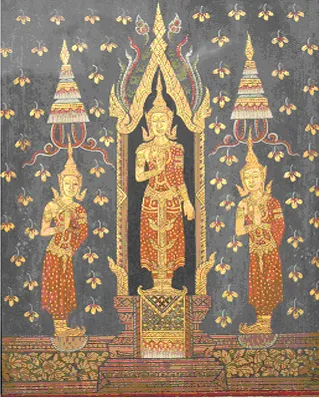
Photo: Anonymous (Thailand)Unknown author, Public domain, via Wikimedia Commons
There's a specific sound Thai horror makes before it hurts you. Not the jump-scare sting. Something quieter — a fan clicking off in a hot room, a fridge humming in a house that shouldn't have power, the wet shuffle of bare feet on tile at three in the morning. If your streaming queue has gotten noticeably stranger in 2026, you've probably already heard it.
Thai horror has been exporting for decades, but this year the pipeline widened into something you genuinely can't scroll past. Trailers with burned-in subtitles are pulling millions of views on US accounts. Letterboxd reviews arrive weeks before a title has a stateside distributor. Discords spin up overnight around films that technically aren't available to rent yet. The vibe is less "foreign film discovery" and more "everyone got the same text at the same time."
Which raises the obvious question: what took so long?
The scare is cheap. The feeling isn't.
Part of the answer is boringly economic. Thai productions have always been able to do a lot with a little — practical effects, real locations, actors who can hold a close-up. When everyone in the industry is chasing ballooning budgets, a movie that can terrify you in a two-bedroom apartment for a fraction of a Hollywood mid-budget is suddenly a very attractive thing to acquire.
But cheapness alone doesn't go viral. What travels is specificity.
Thai ghost stories are rarely about a stranger in the woods. They're about a house you can't leave, a debt you inherited, a relative who won't let go. The ghost is usually a person someone failed — a woman who died owing money, a worker nobody counted, a child whose name got sanded off the family tree. You don't need to know the folklore to feel that. You just need to have ever owed somebody something.
Monks, mortgages, and the ghost as social commentary
Here's where Thai horror diverges hard from the Western template. American hauntings tend to punish curiosity — you opened the door, you googled the legend, you moved into the cheap house. Thai hauntings more often punish neglect. Someone didn't make merit. Someone didn't pay respects. Someone sold the land.
That gives the genre an unusually sharp political edge without ever picking up a megaphone. Buddhism sits in the background the way church bells sit in American horror — as texture, as threat, as the thing that might save you if you handle it correctly. Meanwhile the actual monsters are frequently landlords, factory owners, and family members who did the math and decided a person was worth less than the property.
For US audiences raised on possession movies and haunted asylums, that shift in blame is genuinely disorienting, in the best way. The rules aren't the same. The exorcism might not work. The kindest character might be the one who gets it worst.
Hollywood is already doing the math
You can feel the remake vultures circling. Every time a Thai title cracks a US top-ten list, the same three conversations start: who owns the English-language rights, does the story survive relocation, and — the important one — should it?
Sometimes yes. A tight single-location premise retools beautifully. But the stories that hit hardest in 2026 are the ones welded to a place. A ghost in a Bangkok shophouse is not a ghost in a Chicago walk-up, and the second one loses the specific dread of a building that was never meant to hold that many people. The remake conversation is inevitable. The good news is that a wave this deep means the originals get easier and easier to actually watch, which is the only real win for anyone outside the industry.
What the algorithm got right, accidentally
Maybe the strangest part of the boom is how organic it feels. No studio spent a Super Bowl number to make Thai horror happen. It happened because short clips of a woman standing very still at the end of a hallway are apparently universal, and because subtitle-hesitant viewers discovered they'd rather read than miss out.
For a generation that grew up on five-second clips, a slow scare is almost a flex. You have to sit with it. You have to earn it. And in a feed built for impatience, that's the rarest thing on the internet.
Where to start tonight
Don't go straight for the goriest thing on the shelf. Start with something domestic — a family, a house, a debt — and let the cultural rules wash over you without a Wikipedia tab open. Turn the subtitles on and leave them on. Watch it late, alone, with the AC off.
Then go look up what the ghost was actually upset about. That's where Thai horror does its real damage — after the credits, in your head, when you realize the monster was never the point. The monster was just the invoice.
Offspring TH covers the culture before the mainstream catches it. This is one of those moments — get in early.